Lens Reflection: Community Organizing

Initially, I thought the idea of community organizing was very daunting.  It seemed impossible to organize large masses of people into one group with a common interest and goal in mind.  Although I still believe this to be true, the guest speakers made starting small and growing from there was just as effective when functioning as a community. A community does not necessarily have to be made of hundreds of people.  A close-knit group of even around five people can have a momentous impact when used effectively.  This idea definitely eases me mind when I think about how to get people together.  It will definitely be easier to gather a handful of people rather than twenty or fifty plus.  As long as you are passionate and determined to achieve the change you want to see, it is possible.

Rallying support can start with a few core members who spread their message to others and this pattern can continue until a community in the hundreds can come together with time.  One thing to consider progressing with this issue is creating a concise purpose and goal that is universal among members and easy to pass along to others.  Spreading a message is a delicate balance between providing enough information about your cause, but not adding too much where it can’t be easily passed along and digested by others.

The biggest takeaway from this session and the guest speakers is coming to realize that organizing people doesn’t have to be an arduous task.  It is possible to if approached as a step by step process.  Breaking down a large task such as creating a passionate community is a smart idea.  I will start small and get larger.  Firstly, I will gather friends who I feel comfortable working with and having by my side.  I think approaching this issue as a team will be a smarter than approaching it alone because it allows for a more holistic view of the issue rather than being solely based on my biases.  One of the first steps I foresee happening is developing a goal.  The goal will not be something seemingly impossible such as “change society” but rather locate and talk to local organizations who deal with sexual assault cases and victims and rally their support.  Each goal will be something small and achievable that will eventually add up to a bigger picture.

Through the Lens: Community

Being part of a community is a very important aspect to humanity and society.  Through communities, a feeling of fellowship with others is created.  Amongst the members, common attitudes, interests, values and goals are usually shared.  This connectedness found within a community of people is what drives social and political change.  When people who are passionate about certain issues allow themselves to work together to make the change they want to see happen, the collective power increases.  Through community organization, rallies, protests, and demonstrations can take place in order to tackle issues and inspire change.

Communities that develop around rape culture and sexual assault issues are built on the shared values and goals of the collective.  They can be a result of locality, national distaste, and personal affiliations.  Whatever the reason, they create strength in numbers and instill a sense of confidence when bonded together.  There are several communities that have engaged themselves in protesting various aspect of rape culture in society.  There are many support groups that have victims come together to work through personal challenges as well as smaller, local groups that focus on gathering people for protests and marches in response to various sexual assault cases.  Some campus communities, such as one in Isla Vista, California, rally students and community members together to take a stand.  In Isla Vista, students and community members alike gathered for what student organizers called a “Rally Against Rape Culture” where the goal was spark further discussion of what rape culture truly means.  Student created communities such as this exist across the nation’s university campuses.

Community organizing can be a challenge of its own.  There are many people who don’t share the same beliefs, values, or goals that I possess.  Although this diversity can be a constructive thing, it will be harder to weed through those who do and don’t fall in the same category as I do.  Another issue that I foresee being a challenge is having those who do want to see change actually come forward to try to take the necessary actions to see it happen.  There are many reasons which would prevent people from getting involved ranging from laziness to being scared.  The fact of the matter is you can’t make people join your community; they have to want to, and you have to make them want to.  Providing people enough reason and motivation in order to do so will be a difficult task not knowing what it takes to convince people to join a cause.  It is also important to remain cognitive of the fact that some people within the community are victims and that everyone in the community has had a different experience within the realm of sexual assault and/or rape culture within in the United States.  Being patient, understanding, and cautious are all things that any organizer will need to take into consideration.

Many of the people who are actively part of a community most likely fall somewhere on the Citizen Model.  Community organizing helps spread awareness of certain issues, even here on Ohio State’s campus.  I know for a fact that many people are signing petitions to introduce various pieces of legislature, such as Marcy’s Law, to the house-floor (personally responsible citizens).  The people who are going around, informing the public, and asking for signatures are actively participating and taking on bigger leadership roles (participatory citizens).  Lastly, there are people out there seeking a larger, more justice oriented solution to the issue.  This type of devotion is more difficult to come by because it requires an assessment of social, political and economic structures, as well as knowledge about social movements and how to effect systemic change.  The people who are justice-oriented citizens dive deep into the issues and analyze how and why it is and still is an issue.  People like Jackson Katz who seek to dig to the root of why sexual abuse, rape and violence remain problems are considered justice-oriented citizens.

Katz’s TedTalk, “Violence against women – it’s a men’s issue” explores how so-called “women’s issues” are intrinsically men’s issues.  Katz puts aside the women side of this issue to explore why men in particular are abusive, what causes them to become abusive, and how society grows abusive men.  He acknowledges the whole spectrum of victims and assailants, and urges society to stop thinking of this issue as simply a women’s issue.  Society, according to Kutz, needs to obtain a broader outlook on this issue.  No longer should only women become actively involved in trying to change the way society views and functions as a result of rape and sexual violence, but everyone, as a community, should see the issue as a problem with society and work together to begin the change and encourage the transformation.

Link to Katz’s TedTalk: https://www.ted.com/talks/jackson_katz_violence_against_women_it_s_a_men_s_issue/transcript?language=en#t-464854

Through the Lens: Political Action Reflection

Councilmember Brown reminded me a lot of Leslie Knope: strong, opinionated, independent, and full of love for her city.  Hearing her talk about the future of Columbus, her goals and visions for the years to come, and the knowledge she had regarding various issues, was truly inspiring. Having never met a councilmember before, I did not know the extent of their passion for their work.

Initially, I was uncertain about the best way to get politically involved, nor did I know any of the current issues local government was tackling.  After hearing Councilmember Brown speak on some of the issues being handled around Columbus, I think I will need to consider what councilmembers and other government officials deem as priority issues.  There are many pressing issues occurring in and around the city of Columbus, and not all issues can be tackled at once.   I believe much of political involvement needed to reform places like OSU campus would involve getting permission to trial run sexual assault reporting solutions such as the one discussed in Jessica Ladd’s TedTalk.  Political action for a societal issue such as rape culture and inappropriate sentencing of assaulters rests heavily on the national government.  Although it was informative on how the local government handles issues brought forward by citizens, I am still questioning the national government would be so accommodating.

Councilmember Brown really highlighted just how willing members of local government are to work with citizens.  One of the biggest takeaways of her interview was coming to understand that people in power are ready and prepared to listen to the concerns of local citizens.  It is nice knowing that some people use their political authority to make the differences people want to see.

Issue Exploration

Although this world is filled with many issues needing reform and solutions, three issues I chose to focus on include food security in India, the homeless pet population, and rape and sexual assault culture.

Everyone, no matter age, race, culture, or location deserves the right to food security, the right to live in a state of having reliable access to a sufficient quantity of affordable and nutritious food.  Although this is the ideal situation, many people around the world lack this basic human need.  In India specifically, many people struggle with poverty and hunger as India copes with such an immense population.  According to the Food Security Portal, India’s poor population amounts to more than 300 million people, with almost 30 percent of India’s rural population living in poverty.  The malnutrition and under-nutrition many Indians are struggling with is a fast-growing health concern.  When becoming involved in the issue of food security, for India and other food-insecure countries, a personally responsible citizen wanting to help will donate money or canned items to food collection operations trying to make an immediate impact on the problem.  Participatory citizens will attempt to make a bigger impact, and take on a bigger role within the issue at hand.  This could mean organizing the food collection efforts, or advocating for policy changes that will improve food security for those suffering from poverty and hunger.  Justice oriented citizens will investigate further in to the problem and try to find a long-term, sustainable solution.  They could see how different practices, such as sustainable agriculture and agricultural biodiversity, could benefit areas suffering from inadequate food sources.

Each year, approximately 2.7 million animals are euthanized (1.2 million dogs and 1.4 million cats) according to the ASPCA. Overpopulation of shelters and staggering population sizes of homeless and abandoned pets are only some of the root causes to such statistics.  As someone who knows the love and loyalty a shelter pet can bring, it saddens me to know that they are sometimes seen as undesirable to the point of being euthanized.  Every animal deserves a loving home, and seeing stray and abandoned animals left to die on the streets and in kill-shelters solidifies that idea that grateful animals such as shelter pets will never have the opportunity to fill someone’s life with unconditional love and happiness.  There are many extending branches that add to the complexity of this issue.  Not only are shelters overcrowded, copious amounts of homeless and abandoned pets exist, but branches such as puppy-mills, breeders, and the idea of spaying and neutering pets all play a role in the amount of euthanized animals.  Shelters are overcrowded because stray animals are not spayed or neutered and thus they continue to populate the homeless animal population.  When people bring these animals to shelters, it only adds more stress on the shelters to increase adoption rates to avoid euthanizing animals.  However, even though many people adopt, some still prefer pure-breed animals bought from pet stores whose suppliers are mass producing puppy mills or breeders who charge up to thou
sands of dollars for their animals.  In addition, the animals that are brought to shelters are primarily mixed breed dogs that include many breeds that have been given bad reputations such as Pitbulls, American Stafford Terriers and American Bull Terriers.  Another problem shelters face is low adoption rates of elderly or needy animals.  There is no denying the cuteness of a little puppy or adorable kitten, but this desire for young pets often gives elderly animals less of a chance for adoption.  This complex web has many sides to which change can begin with.
Personally responsible citizens whose values and morals are well-shaped may wish to donate money or supplies to shelters.  These donations will keep more animals housed, while also giving shelters the ability to spay and neuter adoptable pets.  Participatory citizens will take on a bigger role, perhaps by promoting the “adopt don’t shop” slogan, and maybe even adopting for themselves.  One less animal left in shelters equals one more animal with a happy home and potential for more animals to find their forever home.  Justice oriented citizens will investigate how to solve these issues on a broader scale, diving deeper into the idea of exposing and shutting down puppy mills or providing affordable spaying and neutering procedures.

Rape culture is defined as “a society or environment whose prevailing social attitudes have the effect of normalizing or trivializing sexual assault and abuse.” Coming to college has made this culture feel all too real, hearing terrible stories, watching news broadcasts talk about Brock Turner’s freedom, and knowing that rapists and sexual predators walk the streets around me.  People shouldn’t have to worry about walking places alone, or arm themselves with pepper spray, constantly having the small canister ready for aiming.  People shouldn’t have to worry about people not believing them or live in fear that their assaulter could strike again.  In a society that seems to make a joke about rape and sexual assault cases, it has become increasingly clear to me that this is an issue I will no longer be observing through a television screen.  With statistic such as 1 in 5 women and 1 in 16 men are sexually assaulted while in college (National Sexual Violence Resource Center) with 63% of sexual assaults not being reported, it has never been more vital to raise awareness and speak out against a culture that blames the victims or makes excuses for sexual predators.  Personally responsible citizens will be formed of good character: honesty, responsibility, caring.  These citizens will not only not participate in acts of sexual violence, but will try to prevent it and report it when it is being observed.  They will not be bystanders.  Participatory citizens take action and engage themselves in the issues surrounding their communities.  They help a victim, share resources, are the resource.  Lastly, justice oriented citizens dive deeper, seek answers, question and debate, and promote structural changes to patterns of social injustice.  Citizens who wish to take such actions may find themselves actively protesting, informing, engaging, and reforming society.
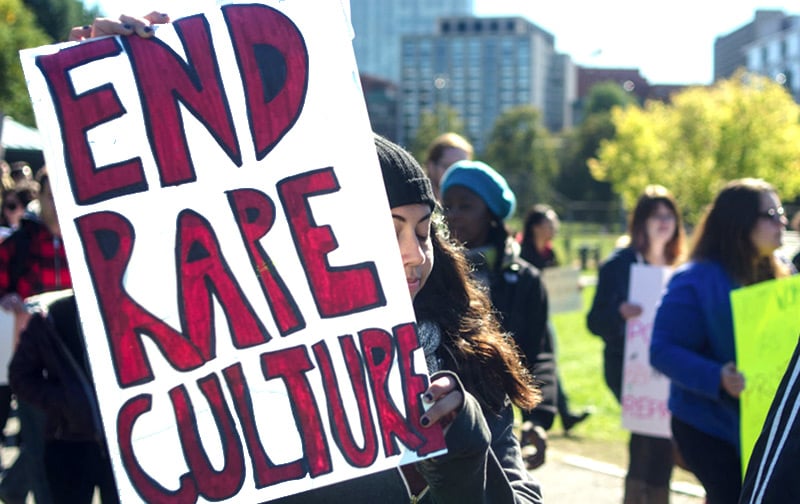
As I explore this issue of “rape culture,” I will definitely have to learn to keep my emotions controlled and myself level-headed.  Because this is an issue I feel strongly about, learning to stay rational and calm when faced up against people who may not feel the same way as me will be a challenge all in itself.  It will be hard for me to listen to others’ opinions that oppose mine, but allowing myself to hear various sides to this issue will help me gain an understanding of what actions I need to take to see the change I want.  I also believe I will run into issues getting my ideas and points across.  It will be hard to get large populations to listen to me, especially those who already know society’s views on rape culture.  As I dive deeper into this issue, I intend to educate myself in various forms to help prevent sexual violence, sign relevant petitions and legislation, and hopefully integrate some various forms of art to bring attention to the issue.


Through the Lens: Political Action

Now, more than ever, rape culture and sexual assault incidents are more closely tied to politics.  With increasing frustration over prominent rape and sexual assault cases, to some extremely questionable remarks made by President Trump, citizens nationwide are expressing concern over the safety of victims and the so-called “punishment” of assaulters.  The United States Department of Justice reports that rape or attempted rape occurs nearly every five minutes in the United States, yet even with a seemingly shocking statistic such as this, it is misleading because many rape causes go unreported.  Even more shocking in this “rape culture” the United States as engulfed itself in is the idea of vilifying victims and accusers of rape.  Many victims are accused of lying and can be put on trial themselves.  It is a horrible truth that many U.S. citizens recognize rape-case phrases that blame the victim such as “she was asking for it,” “you should have seen the way she was dressed,” and phrases that defend the assaulter such as “they were drunk,” “they didn’t know any better,” and the famous defense, “boys will be boys.” Public outrage has skyrocketed since cases such as Brock Turner’s, making many people question the role politics, especially the judicial system, is playing in cases involving sexual assault.  Brock Turner was guilty on all following charges: assault with intent to commit rape of an intoxicated or unconscious person, penetration of an intoxicated person and penetration of an unconscious person. The maximum sentence was 14 years, the prosecution aimed for 6, the judge delivered a minimal 6 months, yet Turner only served half of that sentence.  With a court system that hands out such mediocre penalties, and a President who expects sexual assault in the military, repeatedly calls women “bimbos,” fat, and ugly, sexualizes his own daughter and has reportedly said some very disturbing comments are grabbing women in certain places, rape culture, sexism, and politics have never been so interrelated.

Many people are seeking to protest, advocate, and share their voices on such an important topic.  People are signing petition after petition, ranging from the removal of sexist judges such as Brock Turner’s, to ones that allow victims to know when their assaulter have been released.  More and more statements are being made through art, music, and poetic expression, raising awareness of an issue that stems from this backwards thinking of victim vs. assaulter.

Personally, I hope to become inspired and start the fire inside me in order to create art that serves as a message to our society.  Rallying people together, gaining numbers, and seeking to reform the very fibers of society that condone such a culture will be difficult.  It is not an easy task to dissect a culture and society’s roots to the core in order to reshape, or even destroy, the way society, as a whole, partakes and reacts to sexual violence.  Too much time has passed where American society has allowed this deplorable culture to exist and grow deeper in to the core of American beliefs, but just as much time exists to put forward the effort to condemn it.  It is important to realize many people may not share the same values as me, or those who agree with my opinions.  Different experiences and surroundings have shaped people into truly unique individuals.  Patience, courage, and the ability to express the passion I feel towards changing society’s view on this issue will need to be exhibited before any political change to the issue can be enacted.  I believe the first step is encouraging society to reform our culture, forcing the politics surrounding sexual violence and assault to transform.

Jessica Ladd’s TedTalk “The reporting system that sexual assault survivors want” elaborates on the fact that many sexual assault cases go unreported, in fact, less than 10% of cases are reported on college campuses alone.  Furthermore, on average, victims wait nearly eleven months before reporting.  The vilification of victims that our own society has coined often keeps many victims quiet.  This silence, although understandable, allows assaulters to continue assaulting.  A new reporting system is being tested on two college campuses where victims can report their assault online, in a time and place where they felt safest.  This ensure that victims no longer have to face someone who may or may not believe them.  This new reporting system grants victims the ability to place a secure timestamp document that preserves evidence even if they don’t want to report yet, and gives them the ability to report the assault only if the same assaulter victimized someone else.  A system like this will increase reports, decrease repeat offenders, and decrease sexual assaults by nearly 59%.  By giving victims a safe place to report in the first place, perhaps the unwanted politics of sexual assault can be eliminated altogether.

Jessica Ladd’s TedTalk can be found at this link: https://www.ted.com/talks/jessica_ladd_the_reporting_system_that_sexual_assault_survivors_want#t-321145