The background research team would like to welcome you to their official page! In the tabs above you will find the collective research efforts of the entire team. Content will be updated as it becomes available and the project evolves. If you have any questions please feel free to contact me (James Roche.71) or any of the group members listed in the footer!
Author: James Roche
Injury Statistics
No industry is without its hazards. The following are some statistics on hazards unique to the brewing industry:
- A 2011 study by NIOSH (National Institute of Occupational Safety and Health) indicated that 50% of employees in a Colorado craft brewery felt that their safety training was not sufficient
- It was additionally stated that these people did not feel their safety procedures were adequate.
- Between 2003 and 2011, OSHA found 547 violations (250 serious) at craft breweries
- Large breweries had 151 violations (69 serious) comparatively
- Only 18 serious injuries or fatalities between 2001 and 2009 in breweries
- Despite low number, when accidents happen, they are usually relatively serious
- Chemical burns, carbon monoxide exposure, Explosions
- Despite low number, when accidents happen, they are usually relatively serious
- Two-thirds of all serious accidents or fatalities in breweries come from large companies
- Miller, Anheuser-Busch
- Small breweries have an estimated 4 times as many safety violations, however
- There’s also the possibility of unreported incidents
Electrical Safety
Water Proof Electrical Safety Plugs by Meltric
- Used to make/break electrical connections with live wires
- Connections occur in enclosed chamber to isolate users from live parts
- Spring loaded for secure connection
- Cannot be removed until load is safely disconnected

Ergonomic and Other Physical Hazard Solutions
There are multiple ergonomic solutions out there for brewers. Some are as simple as rethinking technique, while others involve technological innovations:
- Issues with lifting
- Automated processes such as conveyors
- Utilizing fork lifts (this also improves efficiency in moving volume!)
- Training on proper lifting technique (lift with your legs!)
- Employee stretching programs
- Lifting with a buddy!

- Hazards from walking and working surfaces
- Keeping aisles free of obstructions
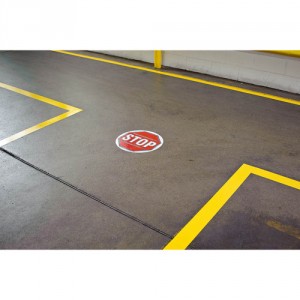
- Marking aisles so everyone knows where common walking space is
- Cleaning up all spills immediately
- Monthly company inspections to identify hazards
- Falls
- Utilization of toe boards on elevated walkways
- Swing gate implementation on openings
- Slip resistant treads added to stairways
- Confined Spaces
- Confined space permits
- Designation of a hole watch

Physical Hazards
Whether it be due to the nature of the brewing process as a whole or simply because some craft breweries are limited in space, physical hazards also plague the brewing industry. Product designers may want to consider designing products that aid with the following:
- Confined spaces
- OSHA defines confined spaces as vessels or containers that “[are] not necessarily designed for people, they are large enough for workers to enter and perform certain jobs. A confined space also has limited or restricted means for entry or exit and is not designed for continuous occupancy.”

- OSHA defines confined spaces as vessels or containers that “[are] not necessarily designed for people, they are large enough for workers to enter and perform certain jobs. A confined space also has limited or restricted means for entry or exit and is not designed for continuous occupancy.”
- Heat and Contents Under Pressure
- Multiple boiling operations involved in pressure vessels throughout breweries
- Equipment must be thoroughly inspected to ensure safety of employees
- Perhaps there is potential for a designed product to make vessel inspections easier
- Electrical shock
- Wet environment of a brewery leads to increased risk of shock when technicians are working on panels
- Design idea: Insulated everyday tools specific to electrical applications
- Wet environment of a brewery leads to increased risk of shock when technicians are working on panels
Ergonomics
There are currently multiple ergonomic problems plaguing the craft brew industry. Many of them are applicable to Land-Grant Brewery! For example, Land-Grant’s current methods for expired product disposal present chances for slipping (beer is usually all over the floor), cuts and scrapes (nail board used to puncture cans as well as sharp can edges), and ultimately chronic pain from the repeated action of cutting open cans. Improving ergonomic conditions will lead to reduced risk of injury, greater long-term productivity, and reduced financial impact of on-the-job injuries.
Ergonomic Problems can be split into two main categories for breweries:
- Musculoskeletal Disorders
- Caused from repeated motions, awkward postures, and high loads
- Lifting malt bags or buckets while climbing ladders
- Lifting or transporting kegs (either full or empty
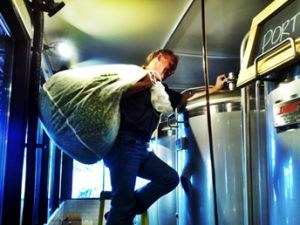
- Caused from repeated motions, awkward postures, and high loads

Slip,Trip, and Fall Hazards
- By the simple nature of being a brewery, there is always a chance for product to be present on the floor
- Trips may come from loose hoses, uneven surfaces, or periodic floor drains
- Rule of “three points of contact” with climbing surfaces is often disregarded
- Many platforms and surfaces within breweries lack proper rail protection for falls

Craft Beer History
- With the rise of prohibiton, over 800 U.S. breweries were forced to close
- Production of beer/alcohol shifted widely to the mob and other underground entities
- Repealing of prohibition resulted in only approximately 300 returning
- This greatly slowed the progress of a “beer renaissance”
- Led to preference of “quick and cheap” manufacturing over quality
- Those with mass producing capabilities quickly eliminated small brewers in the market
- Craft beer formed as an idea in 1970’s
- Resulted from lack of imports/choice in the marketplace (classic product evolution)
- Brewers wanted to match the taste and style of imports at home
- Craft beer “boom” begins in the 1980’s
- First “Great American Beer festival held in 1982
- Had only 35 different beers
- Today’s festival contains over 2000

Craft Brewing in Ohio
- Central Ohio currently home to 25 craft breweries
- Over 300 restaurants in the Columbus area serve local craft beers
- As shown in the figure below, craft breweries are on the rise at an increasing rate
- Much of this is due to increasing Millennial presence in the beer market
- Majority of craft beer drinkers are between the ages of 25 and 34 (29%)
- Follows general nationwide trends of craft brewing growth
- 55% of respondents of a survey performed by Mintel claimed that they are willing to pay more for craft beers than classic big bands

Craft Brewing Nationwide
Upon further research, information from the year 2014 is the most readily available as it pertains to craft brewing in America. Some speculative data from the conclusion of 2015 is available, but it does not provide a substantial base to discuss from.
- Craft brewing broke 11% market share by volume for 2014
- Drastic increase form 7.8% in 2013
- Due to 18% overall increase in beer production
- Sales in craft beer have increased by 22% between 2013 and 2014
- $19.6 Billion in total sales for 2014
- Compare to $101 billion dollar beer industry nation wide
- Craft Brewers Association aiming for 20% share by volume by 2020


- Overall beer market has been relatively stagnant in recent years
- Minimal increase in overall beer sales (0.5%) from 2013 to 2014
- Despite stagnation of the market, craft brewers are eating the market share of larger, established corporations.
Ancient History of Beer
- Brewing is believed to have taken place since around the 6th millennium BC, although the first-known alcoholic beverage is a 9,000 year old Chinese beverage of rice, honey, and fruit.
- More concrete evidence of beer dates back to the Sumerians of Mesopotamia and ancient Egyptians
- There is a theory that beer may have surfaced as much as 12,000 years ago with the rise of “cereal agriculture”
- Fermentation may have been discovered by accident!