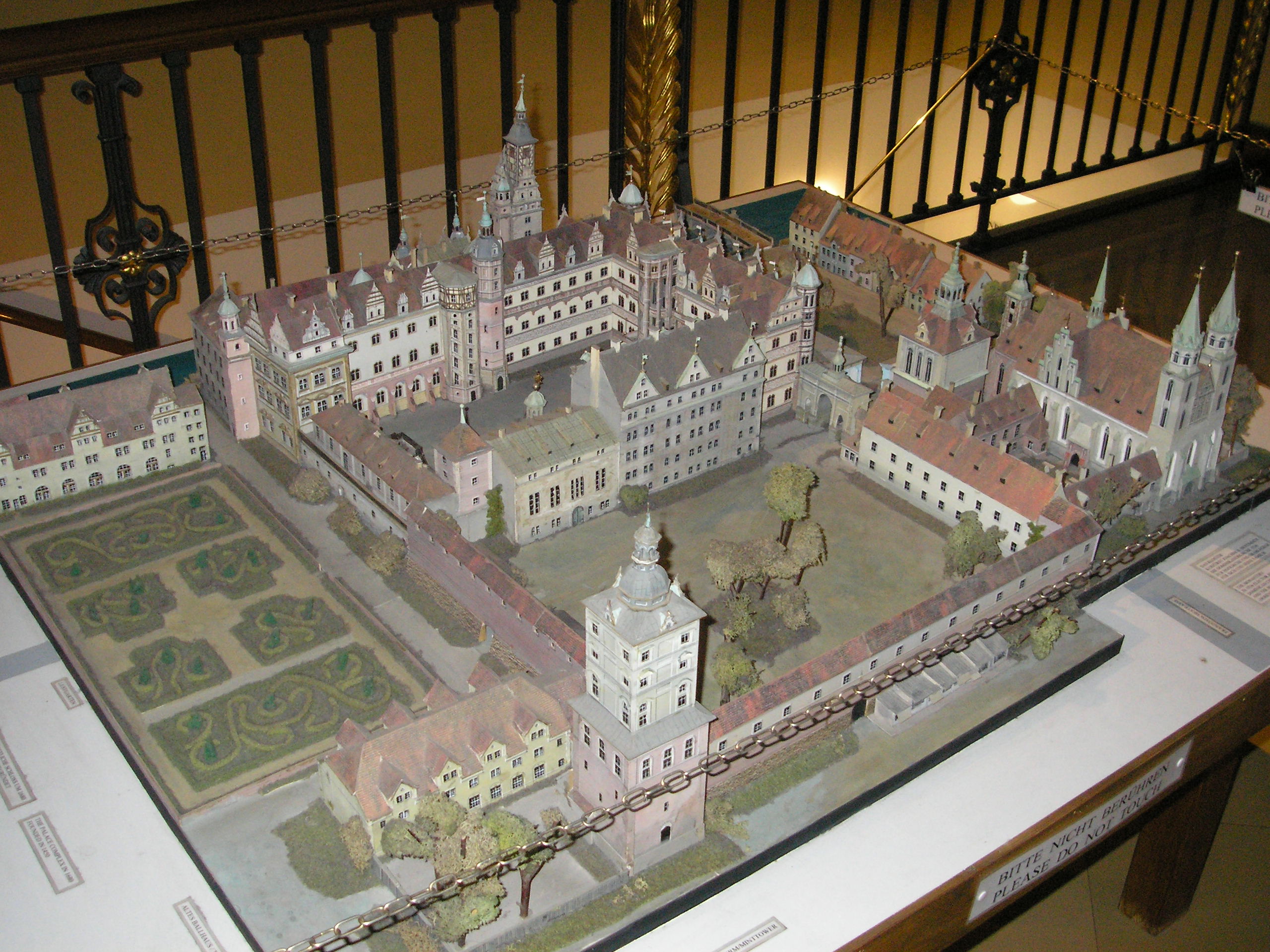
Miniature model of the Stadtschloss Berlin (Renaissance Era)
Located on what is today known as Museum Island, the Berlin City Palace, also known as the Stadtschloss or simply the Berlin Schloss, was one of the many historically significant buildings damaged or destroyed during Allied bombing of Berlin in the final stages of World War II. The attack that crippled the Berlin Palace occurred on February 3, 1945, when several high explosive and incendiary bombs fell on the Palace. Although the following fire “burned for almost four days” (“War Damage”), the structure of the building remained largely undamaged.
The foundations of the original building were first laid in 1443 at the site where the building remained until after the end of the Second World War (Ekici 25). The building during this time was only a castle, but in 1695, construction began on transforming the Renaissance-era building into a royal palace for the Prussians (Boym 181-182).

City of Berlin with the City Castle in 1891. (1)
The Schloss has been renovated and reconstructed many times since it originally begun construction. In 1701, it became the palace for the kings of Prussia and continued to serve Prussia until the emperors of a newly unified Germany took over in 1871 (Ekici 25). Before that, it was the location for popular protests against the Prussian monarchy in the Revolution of 1848. At this time, the Schloss was regarded as a symbol of imperial oppression (Ochoa 17). The Schloss was, in fact, as important to the German monarchies as Buckingham Palace is to the British (Burchard 148).
Until the end of the First World War (1918), the palace remained the seat of German imperial power. After the Kaiser’s abdication, it was used partly as a museum but remained mainly empty (Ekici 25). After its abandonment during the Weimar Republic, Hitler and the Nazis similarly left the building alone, even looking down upon it (Boym 182).

The Stadtschloss on July 16, 1945
After the Allied bombs damaged the building in 1945, its structure remained scarred but secure. “Numerous pictures, sculptures, tapestries, and other works of arts” (Burchard 149) survived the extensive fire damage. Between 1945 and 1948, the building was used to display artwork that the Nazis had labeled as degenerate (Boym 182).
The Schloss’s role at the center of German government remained after the war. Lying in East Berlin, the GDR controlled the immediate fate of the building and decided in 1950 to demolish the historical structure rather than repair it. Although preserving the building would have been of high cost, the most widely accepted explanation of the demolition is that the GDR wished to remove a symbol of Prussian imperial power (Burchard 150)
In place of the Stadtschloss, there was a major parking lot for more than twenty years, until the GDR decided to construct between 1973 and 1976 the Palace of the Republic (Ekici 25-26). The building was constructed of white marble and bronze-colored glass panels (Ekici 26). It housed not only the GDR’s People’s Chamber but also restaurants, entertainment spaces, art galleries, and a bowling alley open to the GDR citizenry (Ekici 25).
In 2003, the German parliament decided to demolish the Palace of the Republic (Ekici 25). The poisonous asbestos used in the building had been removed in the years prior, but the Germans deconstructed rather than demolished the building in reverse order to spare the city sound and air pollution (Ekici 26). For many Germans, the Palace stood as a symbol for the political division of the country (Ekici 27).

View of the west side of the Stadtschloss, 2016.

View of the reconstruction from the Berlin TV tower.
In 2007, the German parliament decided to rebuild the Stadtschloss in its former location. The decision was met with modest support and great criticism. Besides the high cost, the building had never been widely loved among the German citizenry (Ochoa). Under the urban renewal policy of critical reconstruction, however, German leaders and the Schloss’s supporters sought to rebuild the Schloss to provoke a “collective memory through nostalgic representations in Berlin” (Ekici 29). As such, the goal of the reconstruction is to make the Stadtschloss a symbol of unity for the nation: “The Schloß, once a powerful symbol of monarchy, therefore became not only a symbol of urban unity but also a symbol of national unity” (Ekici 28). That symbol, however, comes with a steep cost: an estimated $780 million price tag in 2013 (Görtz).
Planning to be known as the Humboldt Forum and house international displays of art, academia, culture, and science (Ochoa), as well as intercultural events, the reconstruction is still underway in 2016.


